

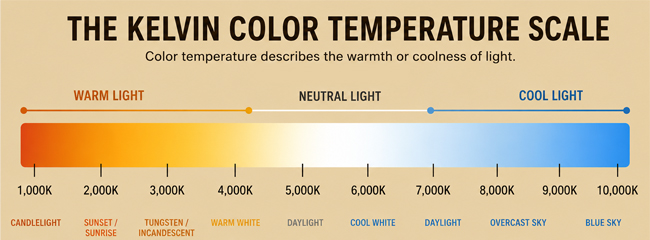
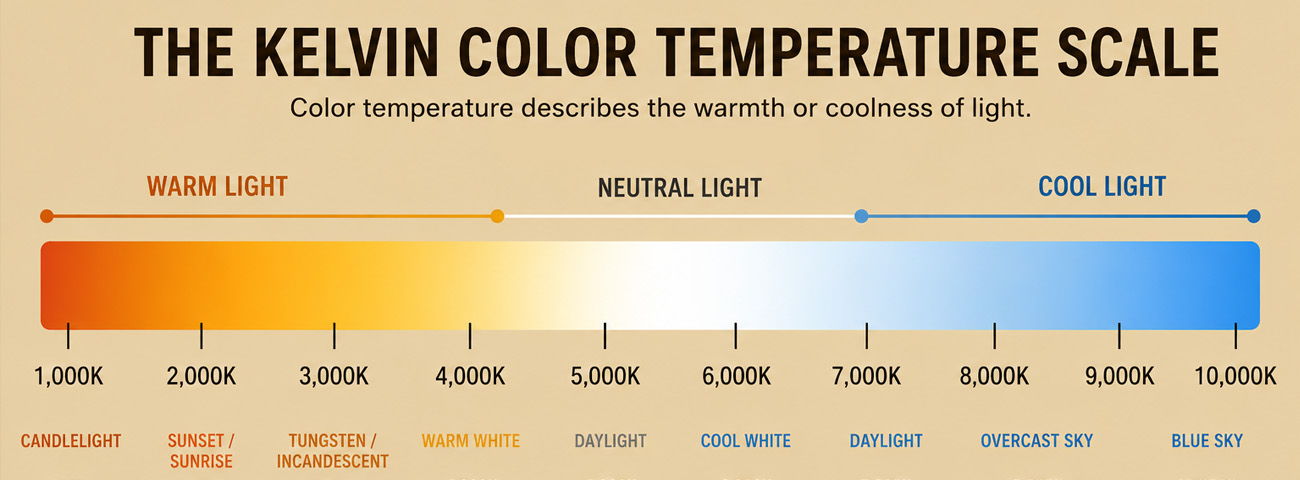
Among photographers, you often hear the anecdote: “Kelvin heated a block of carbon and assigned numbers based on its color change as the temperature increased.” This is the essence of the Kelvin Color Scale.
While this explanation is straightforward, it doesn’t capture the entire story. Why is “White Light” assigned a value of 5200 °K? What does that number signify?
In 1848, William Thomson, later known as Baron Kelvin of Largs in Ayrshire, published a paper titled “On an Absolute Thermometric Scale.” In this work, he introduced a new temperature scale based on his calculations for determining absolute zero—the point at which particles possess no kinetic energy.
Originally referred to as Absolute Celsius, this scale was renamed in 1967 in recognition of Lord Kelvin. On this scale, 0 degrees corresponds to absolute zero (theoretically the lowest possible temperature) while maintaining the same degree intervals as Celsius. Thus, the 100-degree range on the Celsius scale from 0° to 100 °C (the melting and boiling points of water) translates to the adjusted range of 273 to 373 °K.
So, how did a scale intended to define absolute zero become a color scale used in modern digital cameras?
In a classic 19th-century experiment, Lord Kelvin observed the phenomenon of a heated carbon filament in a closed container. As the temperature increased, the filament emitted various colors due to the excitement of the particles. He noted that as the carbon heated up, it transitioned from dull red to yellow and finally to a blue-white glow. Through meticulous observation and complex calculations, Lord Kelvin determined the °K temperature required to produce each corresponding color in the carbon filament. Around 2000 °K, the carbon glows a dark red, shifting to yellow at approximately 3000 °K. At about 5000 °K, the light is considered “White,” similar to natural sunlight, while 7000 °K corresponds to the color of a blue sky.
In simple terms, the higher the Kelvin number, the cooler the light appears. Therefore, while we refer to this gradient of light color as the Kelvin Color Temperature, it actually describes the emitted light wave when carbon is heated to that specific temperature, rather than the temperature of the light wave itself. Ultimately, understanding the concept of placing color on a continuous scale—from infrared to ultraviolet—matters more than the specifics of the number. This framework allows us to calibrate electronics to match existing colors or adjust camera programming to interpret 3200 °K as 5200 °K (White Balance), ensuring that white objects in images appear accurately without a yellow tint.
Photographer: John Baltz
 John is a seasoned professional with nearly 30 years in photography. A native to Northwest Arkansas, John’s first interest in photography began with collecting cameras as a child from antique markets around town. Later, John received a degree in Computer Science from the University of Arkansas. It is his strong knowledge in digital photography, along with a love for the the history of photography that provides for a unique sense of creativity driving many of his projects.